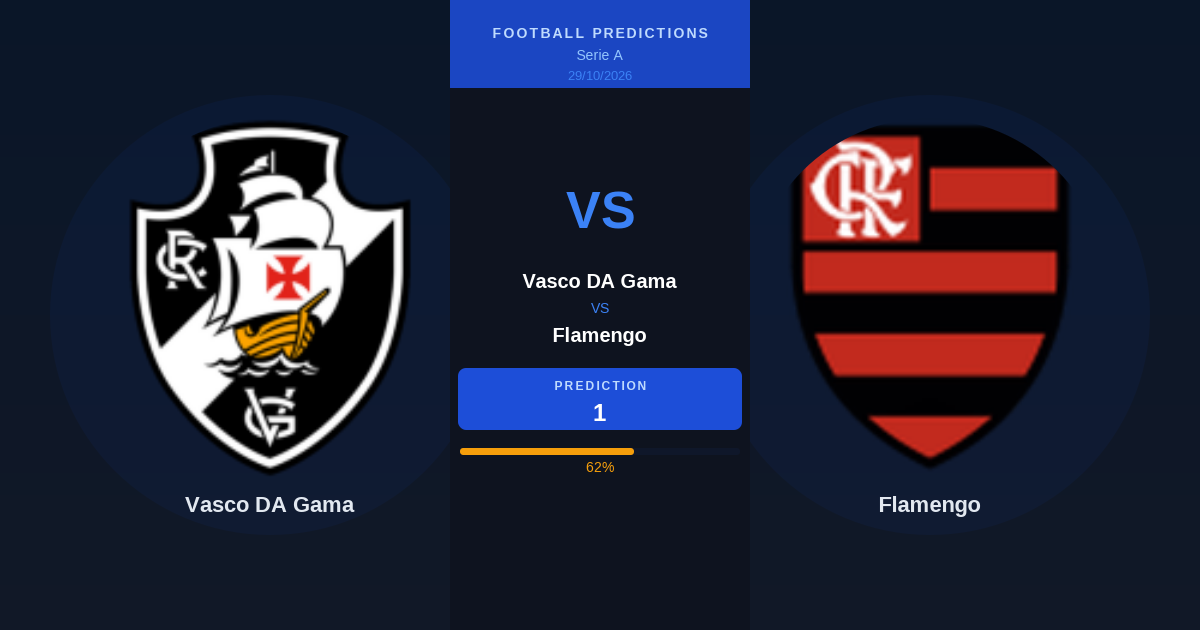
 Vasco DA Gama
 Flamengo
Form Analysis for Betting
Vasco DA Gama's home form has been relatively stable, with seven wins, three draws, and five losses this season. Their ability to score an average of 1.2 goals per match at home, coupled with a total of 21 goals, highlights their attacking potential. However, they have struggled defensively, conceding an average of 1.4 goals per game, which has led to only three clean sheets. Flamengo, on the other hand, boasts an impressive away record with nine wins, four draws, and three losses. They have been prolific in front of goal, scoring an average of two goals per game away from home. Their defensive solidity is evident from the six clean sheets they have kept, conceding just 0.8 goals per match on average. Despite these statistics, the betting market seems to favour Flamengo with shorter odds, likely due to their overall season performance. Yet, Vasco DA Gama's strong home form could defy expectations, offering value to discerning bettors.
Market Analysis and Betting Opportunities
In the match result market, Vasco DA Gama is priced at odds of 3.4, translating to an implied probability of 29.4%. However, the model assigns them a 48% chance of winning, offering a substantial value edge of 18.6 percentage points. A draw is priced at odds of 3.3, with an implied probability of 30.3%, aligning closely with the model's 29% probability, indicating no significant value. Flamengo is priced at odds of 2.05, implying a 48.8% chance, higher than the model's 23%, suggesting no value. The Over/Under 2.5 goals market sees the Over priced at odds of 1.85, with an implied probability of 54%, compared to the model's 45%, indicating no value. The Under 2.5 goals market is priced at odds of 1.95, translating to a 51.3% implied probability, still lower than the model's confidence level. In the BTTS market, 'Yes' is priced at odds of 1.7, with an implied probability of 58.8%, compared to the model's 48%, showing no value. The 'No' option is priced at 2.05, aligning with a 48.8% probability, again not offering value. The Double Chance market for Vasco DA Gama or Draw is priced at odds of 1.73, with an implied probability of 57.8%, slightly above the model's 77% for either outcome, providing a safer, albeit smaller, value edge.
Risk and Discipline Analysis
The potential risks to the Vasco DA Gama win bet stem from Flamengo's formidable away record, which includes nine wins and six clean sheets. If Flamengo manages to impose their defensive discipline, Vasco DA Gama may struggle to breach their defence, undermining the value bet. Additionally, Flamengo's scoring prowess, with an average of two goals per match away, poses a threat to Vasco DA Gama’s defence. The market's odds suggest confidence in Flamengo's ability to perform away from home, but this is where the model's insight diverges. Another scenario that could invalidate the value pick is if Flamengo scores early, forcing Vasco DA Gama to chase the game, potentially exposing them to counterattacks. Bettors should consider the volatility of football matches and maintain discipline with bankroll management. If the odds for Vasco DA Gama drop significantly, reducing the value edge below 10%, it would be wise to reconsider the stake or shift focus to alternative markets.
Concluding Bet Valuation
The strongest value pick is Vasco DA Gama to win, priced at odds of 3.4, with a value edge of 14.4 percentage points over the market. This selection is based on the model's 48% win probability, significantly higher than the implied market probability of 29.4%. For risk-averse bettors, the Double Chance market on Vasco DA Gama or Draw offers a safer alternative, priced at odds of 1.73 with a modest value edge. The primary risk to this bet is Flamengo's strong away form, particularly their ability to maintain clean sheets and score consistently. However, Vasco DA Gama's home advantage and the market's underestimation of their capabilities provide a compelling reason to back them. Should the odds on Vasco DA Gama fall below 2.5, the value edge would diminish, making it prudent to reassess the risk-reward balance.